What Does Charging Really Cost in 2026? Ionity, EnBW, Tesla and More
An honest comparison of the major charging networks in Germany: tariffs, subscriptions, and when each model actually pays off.
If you drive an electric car in 2026, you have plenty of choices. Ionity, EnBW, Vattenfall, Tesla. Every provider advertises low prices, subscriptions, and perks. But what does a kilowatt-hour really cost? And when does each model actually pay off? We looked at the current tariffs and did the math honestly, instead of just repeating marketing claims.
What changed in 2026
The most important move in 2026 came from Ionity. In February 2026, the provider that had long been seen as expensive cut its prices noticeably. The ad-hoc tariff now sits at 0.69 EUR per kWh, the app tariff at 0.66 EUR per kWh.
That sounds modest, but it's a clear signal: competition among high-power chargers (HPC) is heating up. EnBW still beats Ionity on the standard rate at 0.56 EUR per kWh, but Ionity is closing the gap, especially for frequent users with a subscription.
Vattenfall InCharge is also pushing hard with DC prices between 0.44 and 0.49 EUR per kWh. If you charge in public regularly, it's worth comparing tariffs every year.
The main tariffs at a glance
| Provider | Tariff | Base fee | Price per kWh |
|---|---|---|---|
| Ionity | Ad-hoc | none | 0.69 EUR |
| Ionity | App | none | 0.66 EUR |
| Ionity | Motion 365 | 59.99 EUR/year | 0.49 EUR |
| Ionity | Power 365 | 119.99 EUR/year | 0.39 EUR |
| EnBW | Standard (S) | none | 0.56 EUR (DC + AC) |
| EnBW | Frequent (L) | 11.99 EUR/month | 0.39 EUR (DC) |
| Vattenfall | InCharge DC | none | 0.44 to 0.49 EUR |
| Tesla Supercharger | Tesla drivers | none | approx. 0.39 to 0.55 EUR (varies by site and time) |
All prices as of mid-2026. Tesla pricing varies significantly by location and time of day, and is typically higher for non-Tesla drivers.
EnBW: The market leader in detail
EnBW operates Germany's largest fast-charging network and is the first choice for many drivers. The standard tariff (S) costs 0.56 EUR per kWh with no base fee, on both DC fast chargers and AC stations. That makes it refreshingly simple: one price, one app, no hidden costs.
For frequent users, there's the L tariff: 11.99 EUR per month, then 0.39 EUR per kWh on DC chargers. The interesting question is: when does that pay off?
The math is straightforward. You save 0.17 EUR per kWh (0.56 minus 0.39). The monthly base fee of 11.99 EUR is offset at around 70 kWh (11.99 divided by 0.17 = 70.5). So if you charge more than about 70 kWh per month at EnBW DC chargers, the L tariff is worth it. That's roughly one full charge of a Model Y.
Ionity: is the subscription worth it?
Ionity offers two annual subscriptions, and both look attractive at first. But let's do the math honestly.
Motion 365 costs 59.99 EUR per year, after which you pay 0.49 EUR per kWh instead of 0.66 EUR on the app tariff. That's 0.17 EUR saved per kWh. The annual base fee of 59.99 EUR is offset at 353 kWh (59.99 divided by 0.17). So if you charge more than about 353 kWh per year at Ionity stations, Motion 365 saves you money.
Power 365 costs 119.99 EUR per year and drops the price to 0.39 EUR per kWh. Compared to the app tariff, you save 0.27 EUR per kWh. Break-even: 119.99 divided by 0.27 = about 445 kWh per year. Compared to Motion 365, you save 0.10 EUR per kWh, so the extra 60 EUR per year only pays off above 600 kWh on top of Motion's break-even, meaning roughly 1,000 kWh per year at Ionity stations.
For most drivers who only use Ionity on road trips, Motion 365 is the more realistic option. Power 365 only makes sense if you regularly drive long distances and prefer Ionity.
Which provider for which driver?
Low-mileage drivers (under 5,000 km/year): EnBW Standard (S). No base fee, simple billing, dense network. Commuters with home charging, occasional road trips: EnBW S or Vattenfall InCharge. Both with no base fee and fair DC pricing. Frequent EnBW users (more than 70 kWh/month DC): EnBW Frequent (L). Break-even is reached quickly. Long-distance drivers, regular Ionity users: Motion 365 from around 353 kWh/year, Power 365 only above roughly 1,000 kWh/year. Tesla drivers: Use Superchargers, where prices are usually lowest for Tesla owners.
Tesla Superchargers for non-Tesla drivers?
Tesla has been gradually opening its Supercharger network to non-Tesla drivers for a few years. Prices vary significantly by location and time of day. For Tesla drivers, they typically range between 0.39 and 0.55 EUR per kWh in Germany. For non-Tesla drivers, prices are noticeably higher unless you buy a monthly subscription through the Tesla app.
The upside: Superchargers are generally reliable, fast, and well placed along motorways. The downside for non-Tesla drivers: the cable layout and parking spaces are optimized for Tesla vehicles, which can be awkward at some stations.
For Tesla owners themselves, the Supercharger network is often the cheapest and most stress-free option on long trips, especially when the onboard computer plans charging stops automatically.
FAQ
Which provider is really the cheapest in 2026?
Is a charging subscription worth it if I mostly charge at home?
Are the Ionity price cuts from February 2026 permanent?
Can I use Superchargers without a Tesla?
How much does location affect the price?
Conclusion
The Ionity price cut in February 2026 brought some movement to the market, but EnBW remains the first choice for most drivers. Standard tariff without a base fee for low-mileage users, frequent-user tariff from around 70 kWh per month. If you regularly travel long distances and prefer Ionity, consider Motion 365 from around 353 kWh per year.
Vattenfall InCharge is a quiet favorite for anyone who wants cheap DC charging without a subscription. Tesla drivers still benefit from the Supercharger network, while for non-Tesla drivers it only pays off when the location works out.
Do the math honestly on how much you actually charge in public. Subscriptions sound attractive, but they're only a good deal if you actually reach the break-even point.
Sources: LadeStationGuru 2026, elektroautofahrer.net 2026, wirkaufendeinethg.de February 2026, voylt.com 2026.

Related Posts
Ready for Your Next Adventure?
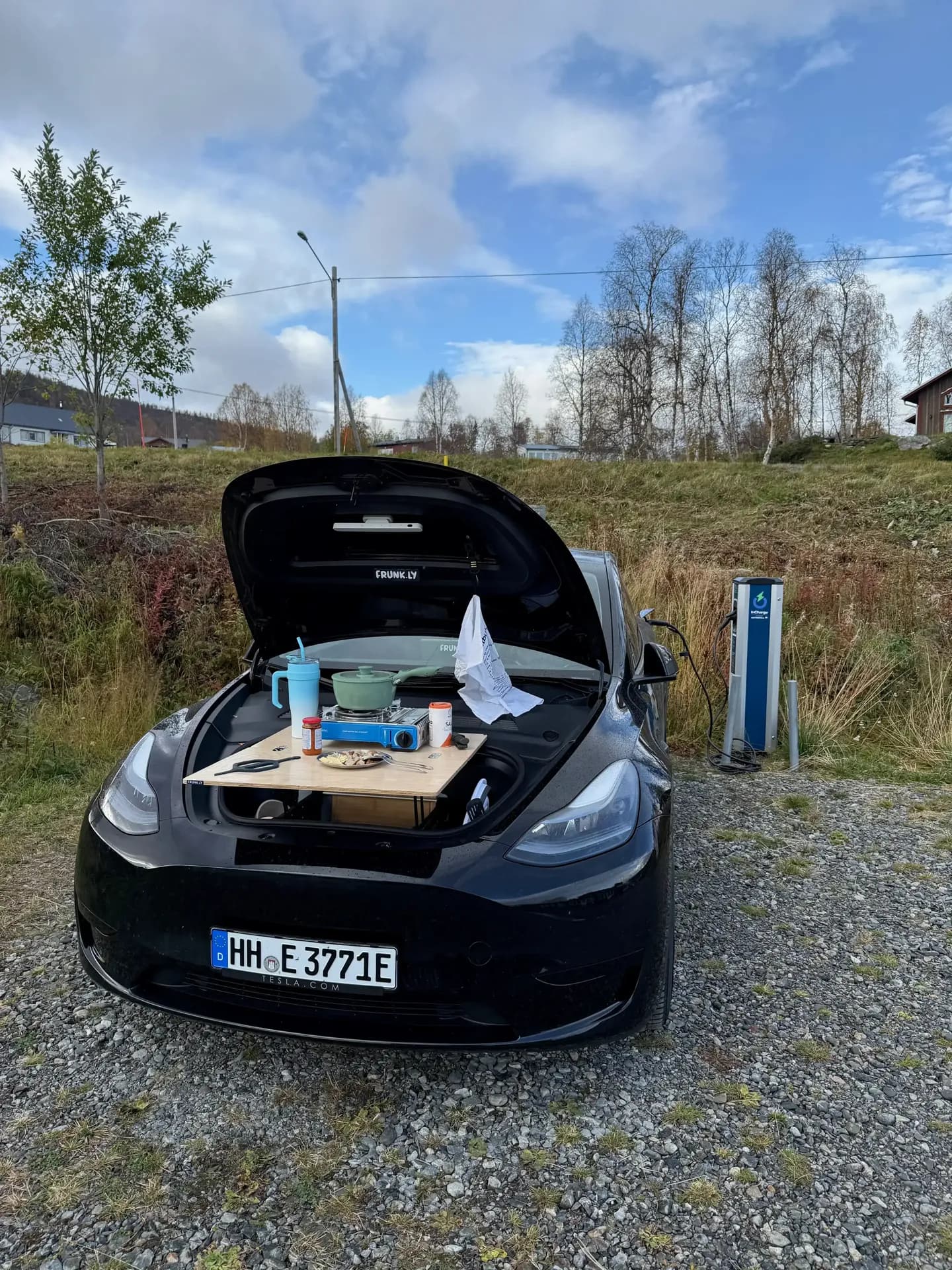
Your Tesla can do more. With Frunkly, transform your frunk into a practical workspace in seconds.