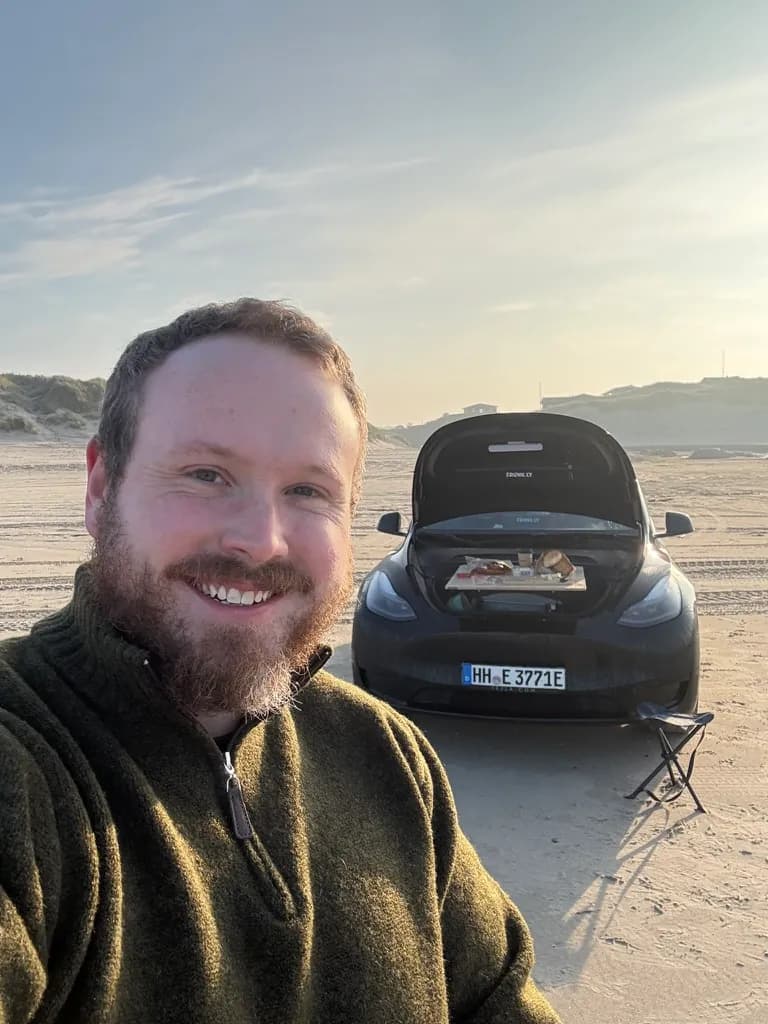
Tesla Camp Mode 2026: Camping and Sleeping in Your Tesla
How to enable Camp Mode, what it disables, what one night actually costs in battery, and what you really need to sleep in your Tesla
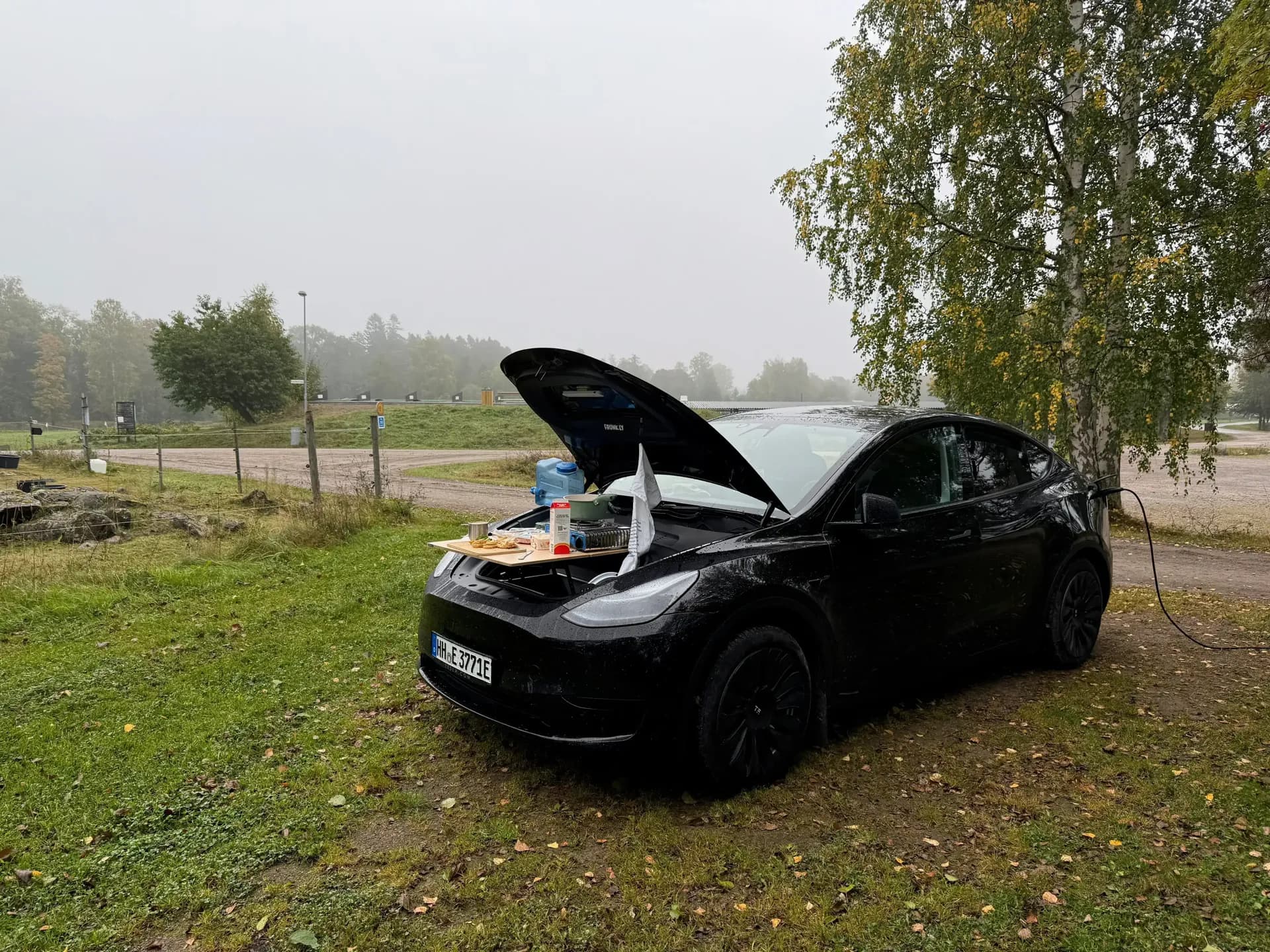
Camping in a Tesla works better than most people think, because Camp Mode automates the right things: climate runs, the touchscreen stays available, USB power for phone and lamp, and both auto-locking and Sentry Mode are off so you can step out and back in without drama. What the marketing doesn't tell you is how much battery a real night costs, where the Model 3 has its step between rear seat and trunk, which window shades are actually worth buying, and why condensation on the inside of the windshield is the biggest issue if you don't manage it.
This guide covers:
- How to enable Camp Mode on the current touchscreen and what it automatically disables
- How much battery a night really costs, with measured numbers from Tesla drivers in 2024 and 2025
- Which Tesla actually works for sleeping (and which doesn't)
- Mattresses, window shades, condensation, and noise
- Where you can legally sleep across Germany and Europe
What Camp Mode does and what it disables
Stays on: climate at your chosen temperature, touchscreen with all apps, cabin lighting, USB and 12V outlets, music, heated seats. Automatically disabled: Sentry Mode (the camera surveillance pauses, otherwise it would flag you every time you step out) and door auto-locking (so you can leave and re-enter without keys). You can still lock manually and manage everything remotely from the Tesla app.
How to turn on Camp Mode
Shift to P
Put the Tesla in Park. Camp Mode can only be enabled with the car stationary.
Open the Climate menu
Tap the temperature reading or fan icon at the bottom of the touchscreen. The Climate menu expands.
Tap "Camp" at the top
At the top of the Climate menu you'll see a row with four modes: Off, Keep, Dog, Camp. Tap Camp. The Tesla logo appears on the screen as confirmation.
Set the temperature
Pick a temperature. 17-19°C is comfortable for sleeping. Important: set the target close to the outside temperature, so the fan runs at a constant low speed instead of spooling up periodically and waking you.
Exit
Tap Off in the Climate menu or open the driver's door. Either ends Camp Mode immediately.
The four climate modes
Off: climate is off. Keep: climate stays on with a "Climate Will Stay On" message, for short breaks. Dog: climate runs and the screen shows a message to passers-by with the cabin temperature, designed for 15-60 minutes. Camp: climate, screen, lighting, and USB stay on, Sentry and auto-lock are disabled, optimized for overnight use.
Battery usage: theory and reality
Tesla quotes about 1% per hour as a baseline. That only holds at mild temperatures between 10 and 20°C. Real numbers reported by Tesla drivers in 2024 and 2025:
| Conditions | Measured drain | Source |
|---|---|---|
| Model 3 (2025), mild night | 14% per night | Torque News, 2024 |
| Model Y, ~10°C, 8h | ~10% | TMC forum, 2024 |
| Model Y, ~5°C, 8h | ~14% | TMC forum, 2024 |
| Model Y, -22°C, 7.5h, set 20°C | 57% (~28.5 kWh) | Drive Tesla Canada, 2024 |
| Model Y, 30°C+ summer | 15% or 7-10 kWh/night | Recharged, 2025 |
Three worked examples:
- Model Y, mild (15°C): Start 60%, end around 48%. Plenty of buffer for the next Supercharger.
- Model 3, freeze (-5°C): Start 60%, end around 30%. Heat pump cycles harder, and Tesla actively throttles climate below 20% SoC.
- Model Y plugged into an 11 kW wallbox: Climate uses 4-5 kWh, while you add roughly 88 kWh. You wake up fuller than you went to sleep.
Rule of thumb: Don't start the night below 25% state of charge if you're not plugged in. Below about 15% Camp Mode shuts off entirely to keep reserve for the drive out.
Reducing consumption
Pre-condition from the Tesla app 15-20 minutes before bed so the cabin is already at target temperature, instead of having to heat it from cold. In winter park facing south to let morning sun help. In summer, park in shade, ideally protected from the late afternoon sun. Window shades cut cabin temperature by 14-19°C on hot days and retain body heat in winter. Setting the target temperature close to the outside temperature keeps the fan at a constant low speed.
Camp Mode vs Dog Mode vs Sentry Mode
Three features, three jobs. Camp Mode pauses Sentry automatically while active.
| Aspect | Camp Mode | Dog Mode | Sentry Mode |
|---|---|---|---|
| Purpose | Overnight stay, long break | Leave a dog briefly | Theft deterrent |
| Typical duration | Hours to a full night | 15-60 minutes | Hours |
| Climate | On, freely adjustable | On, with outside message | Off |
| Screen | On | On with dog message | Off |
| Doors | Auto-lock disabled | Locked | Locked |
| Cameras | Off | Off | On, recording |
| Battery | 1-3%/h | 1-3%/h | approx. 1%/h |
Which Tesla works for sleeping
Not every Tesla is equally good for an overnight. Practical dimensions with rear seats fully folded, measured by actual owners in 2024+ forums:
| Model | Sleep length | Sleep width | Realistic for |
|---|---|---|---|
| Model 3 (incl. Highland) | ~180 cm | 105 cm (narrow), 130 cm (shoulder) | 1 person, tight for 2 |
| Model Y (incl. Juniper) | ~200-210 cm | 104 cm (wheel wells), 130 cm (shoulder) | 2 adults up to ~185 cm |
| Model S | ~211 cm | 104 cm | 1 person, roof tapers at the rear |
| Model X (7-seater) | ~200 cm | up to 145 cm | 2 adults plus kid and dog |
| Model X (6-seater) | not usable | - | Captain's chairs don't fold |
Model Y is the practical sweet spot, the model most Tesla campers in Europe actually drive. Important: it is not actually flat. The folded rear seatback sits at a 7-10° slope and drops by an 8 cm step to the trunk floor. An 11 cm contour mattress (such as Havnby with built-in 7° counter-slope) compensates.
Model 3 has a less pronounced step but less length. Most 2024+ reports recommend an 18 cm contour mattress like Snuuzu or TESMAT with the gap built in. Without a compatible mattress you roll into the step at night.
Model S at 211 cm is long enough for tall sleepers, but the roof tapers toward the hatch and limits sit-up height. Even with a thin 3-4 cm pad your head sits close to the glass.
Model X 7-seater is objectively the best. Both rear rows fold flat and a queen-sized mattress fits. Model X 6-seater is not usable for sleeping: the middle captain's chairs don't fold.
Mattress: the right thickness and the step problem
The two most important decisions for Tesla camping are mattress and window shades. For the mattress, three paths:
Pure air mattress. Cheap, packs small, but below 10°C it gets uncomfortably cold because the air layer conducts body heat downward. It also doesn't solve the step problem. Only good for a one-off summer overnight.
Self-inflating (foam-air hybrid). Tesla sells its own Model Y mattress (189 x 128 x 8 cm, integrated 12V pump). Third-party options like Aerogogo (14 cm, IP68) or Snuuzu offer similar. Best ratio of comfort to packed size and insulation. Price range €200-400.
Memory foam contour mattress. TESMAT, Havnby (with built-in counter-slope for the Model Y angle), Snuuzu. Edge-to-edge cut, eliminates the step entirely, insulates best. Bulky to store, around €600-800.
Optimal thickness by model:
- Model Y: 11 cm is the sweet spot. 8 cm works for light sleepers, anything thinner means you feel the step and the trunk floor.
- Model 3: 18 cm contour mattress, otherwise the step is noticeable.
- Model S/X: 7-10 cm, more eats into sit-up height.
DIY route: custom-cut foam from an upholsterer for €100-150. Make a template by tracing the surface onto wrapping paper.
Window shades: not optional
Tesla campers consistently underestimate the impact of window shades. Three effects:
- Privacy. On a Stellplatz or parking lot, you don't want to sleep behind clear glass.
- Heat in summer: magnetic blackout shades drop cabin temperature 14-19°C on a hot day. Without them, Camp Mode works against the sun and the battery suffers.
- Warmth in winter: Reflectix or insulated shades trap body heat and significantly reduce heater duty cycle.
Three types:
- Magnetic (e.g. EVAAM, Magshade). Fastest install (~1 minute for a full set), best blackout. The pick for repeat campers.
- Suction cup. Cheaper, but suction fails on cold glass.
- Tension rod or pop-up. Bulky to store, no marks on the car.
Panoramic glass roof needs a separate cover. Even with sides shaded, direct morning or evening sun through the roof heats the cabin fast. Tesla's OEM roof shade does little (the glass already has UV coating), but a real cover is worth it.
Reflectix DIY. About €5 per square meter, cut from a wrapping-paper template. Silver side out reflects in summer, in retains warmth in winter. Cover with black fabric for a cleaner look. Functionally as good as bought shades, just less pretty.
Managing condensation
Two adults exhale roughly 0.5 to 1 liter of water vapor over 8 hours. In the Tesla's ~3 m³ cabin volume that lands on the inside of the windows if you don't actively ventilate. 2024 reports of soaked windshields are common.
The reliable combination:
- Keep Camp Mode running. The climate system actively dehumidifies, unlike a pure ventilation mode.
- Fresh air, not recirculation. Recirculation pushes CO2 above 1000 ppm and saturates the air faster.
- Crack a window 1-2 cm. In mild conditions (above 10°C) open a rear side window slightly. Enough for air exchange.
- Wet clothes out of the cabin. Shoes, raincoats, damp towels belong in the frunk, not in the sleeping area.
- Park nose-down slightly. Any condensation that does form runs forward to the windshield, where the defroster handles it on departure, instead of dripping onto bedding.
Noise: HVAC fan and outside world
Tesla owners have measured the Camp Mode HVAC fan at around 28 dB inside the cabin, against an ambient 26 dB in a quiet parking lot. That is objectively quiet, but constant. The most common reason Camp Mode wakes someone up is not the level but the cycling: when the set temperature is far from the outside temperature, the fan periodically spools up to full speed.
What helps:
- Set the target close to the outside temperature. At 8°C outside, 18°C cabin works better than 22°C.
- Foam earplugs (NRR 33 dB). €5 investment with the highest comfort return of any gear.
- Rain on the glass roof: low-volume white noise on the audio system.
- Avoid Autobahn rest areas if you're noise-sensitive. Stellplätze and trailhead parking are noticeably quieter.
The 2025 Juniper Model Y reportedly has a quieter fan per update notes.
Cold-weather camping (down to -10°C is fine)
Camp Mode has been tested operational down to -26°C. Practical zones for comfortable sleeping without being plugged in:
- Down to -10°C: with a heat pump (Model 3/Y from 2021, newer S/X) and a 0°C comfort-rated sleeping bag at 18°C cabin set point, you get through the night easily. Drain 15-20% over 8 hours.
- -10 to -20°C: plan to plug in, or upgrade insulation (Reflectix shades, thicker mattress, -10°C sleeping bag). Drain 25-35%.
- Below -20°C: difficult without a plug, the Drive Tesla Canada test at -22°C showed 57% over 7.5 hours.
Practical tips:
- Pre-condition from the app 15-20 minutes before bed while you're still driving. The cabin is warm when you climb in.
- Heated seats keep working in Camp Mode. Level 1-3 draws a fraction of what the cabin heater uses. Set the cabin cooler (18°C instead of 22°C) and put the heat on your body.
- Sleeping bag rating: for a German winter overnight in Camp Mode at 18°C cabin, a 0°C comfort rating is enough. Without Camp Mode (saving battery), aim for -10°C.
Hot-weather camping (30°C+)
In the height of summer, Camp Mode works harder. 15% or 7-10 kWh per night is typical.
- Shade matters more than orientation. Summer is about sun protection, not capture. Western shade in the late afternoon is more valuable than morning shade.
- Roof shade is required. Solar load through the panoramic roof raises cabin temperature significantly, even at night with residual heat.
- Dry air. The AC dehumidifies aggressively. Multiple drivers report dry mouth after a summer night. An open glass of water in the cabin helps.
- Start at 40% SoC minimum, otherwise Camp Mode shuts down in the second half of the night.
The frunk as separated storage
The sleeping area in a Tesla is tight, every smell and damp patch stays. The frunk is separated from the cabin, isolated from the climate system, and the natural fix. Capacity: Model Y 117 L, Model 3 Highland 107 L, both rated to 50 kg.
What goes in the frunk:
- Food and breakfast for the morning
- A 24 L cool bag (upright in the Model Y, flat in the Model 3)
- Wet shoes, dirty hiking gear, raincoats
- Anything that smells: cheese, coffee, dish soap, gas canisters
- Trash bags until the next bin
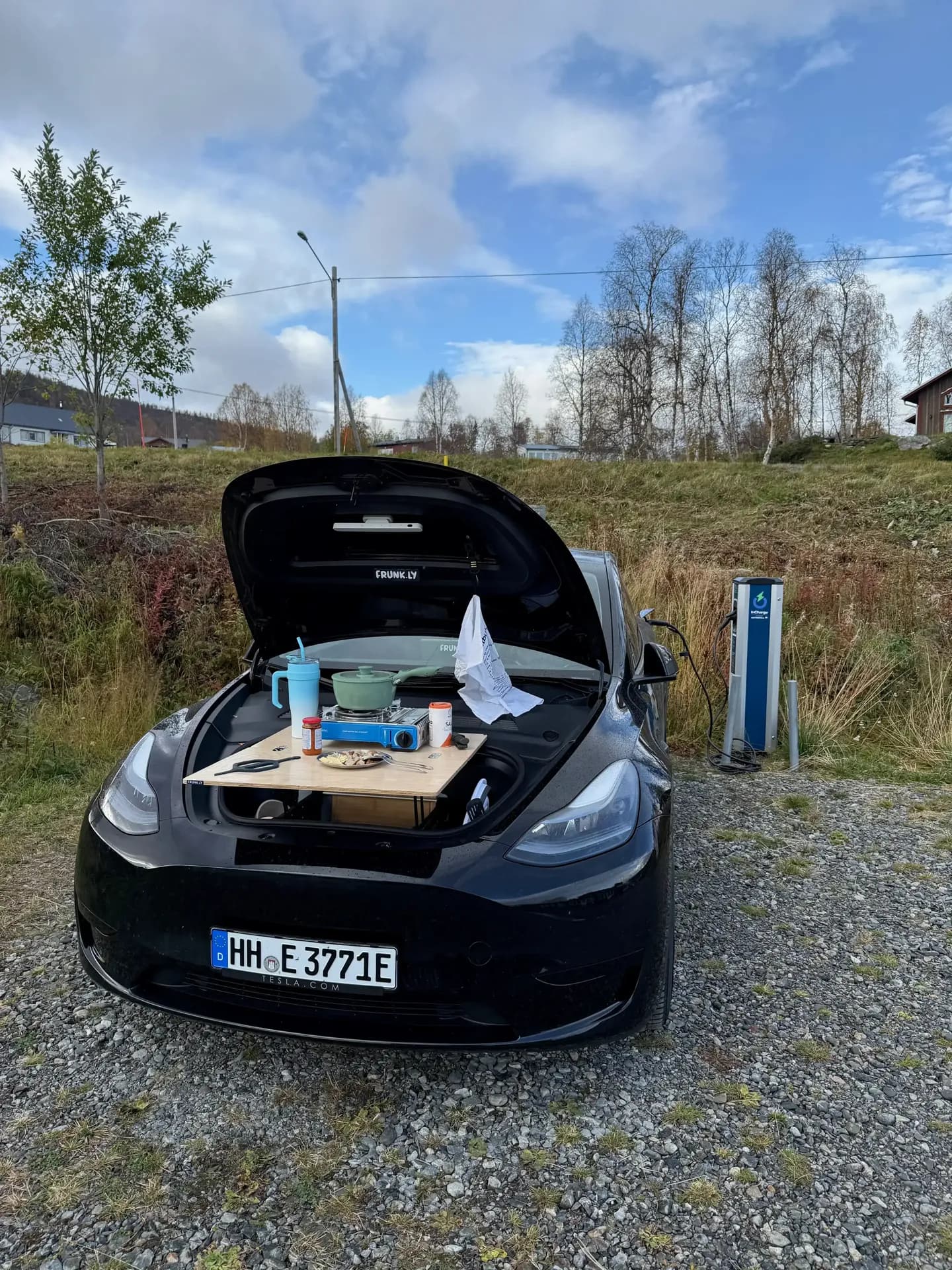
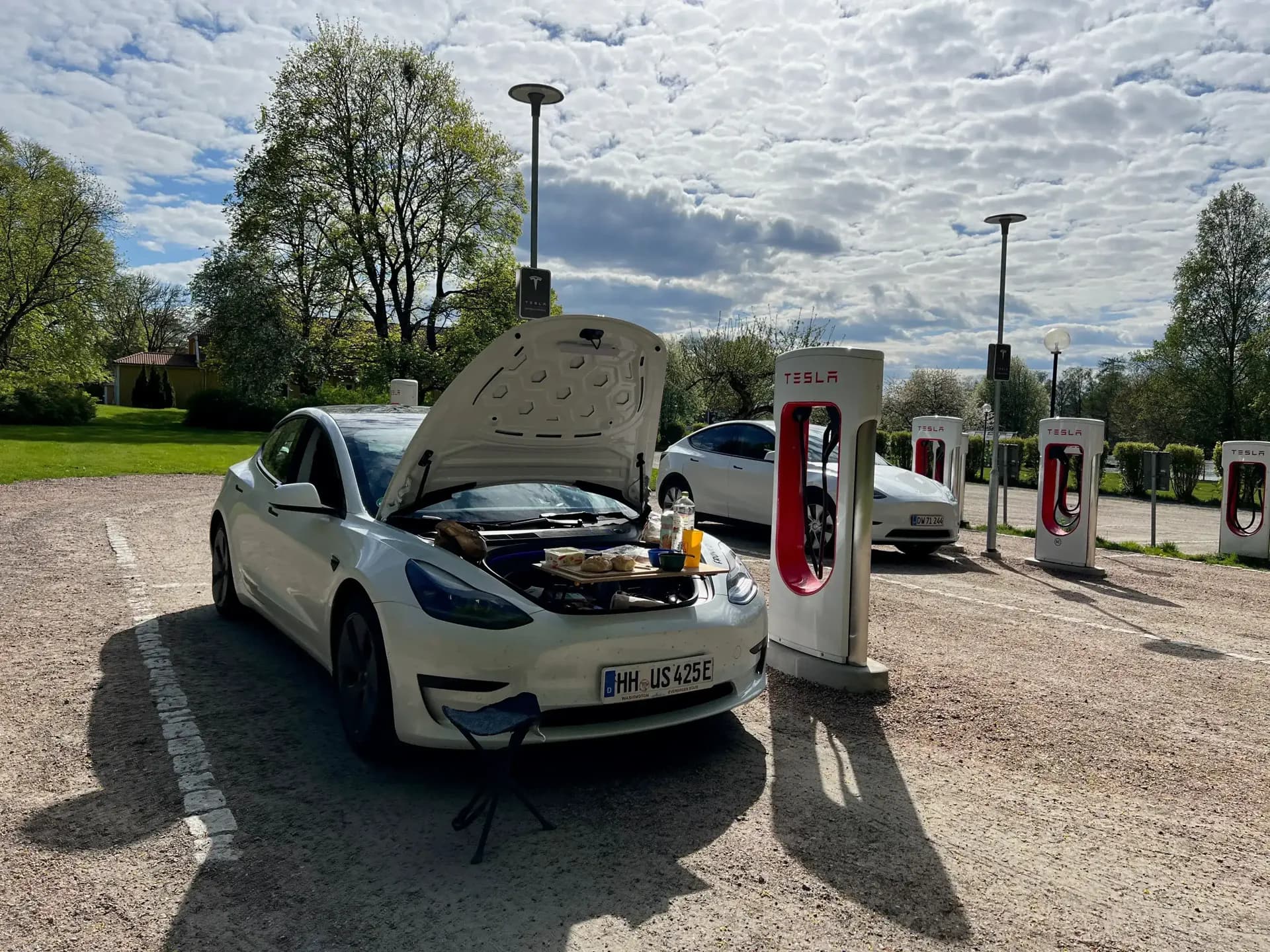
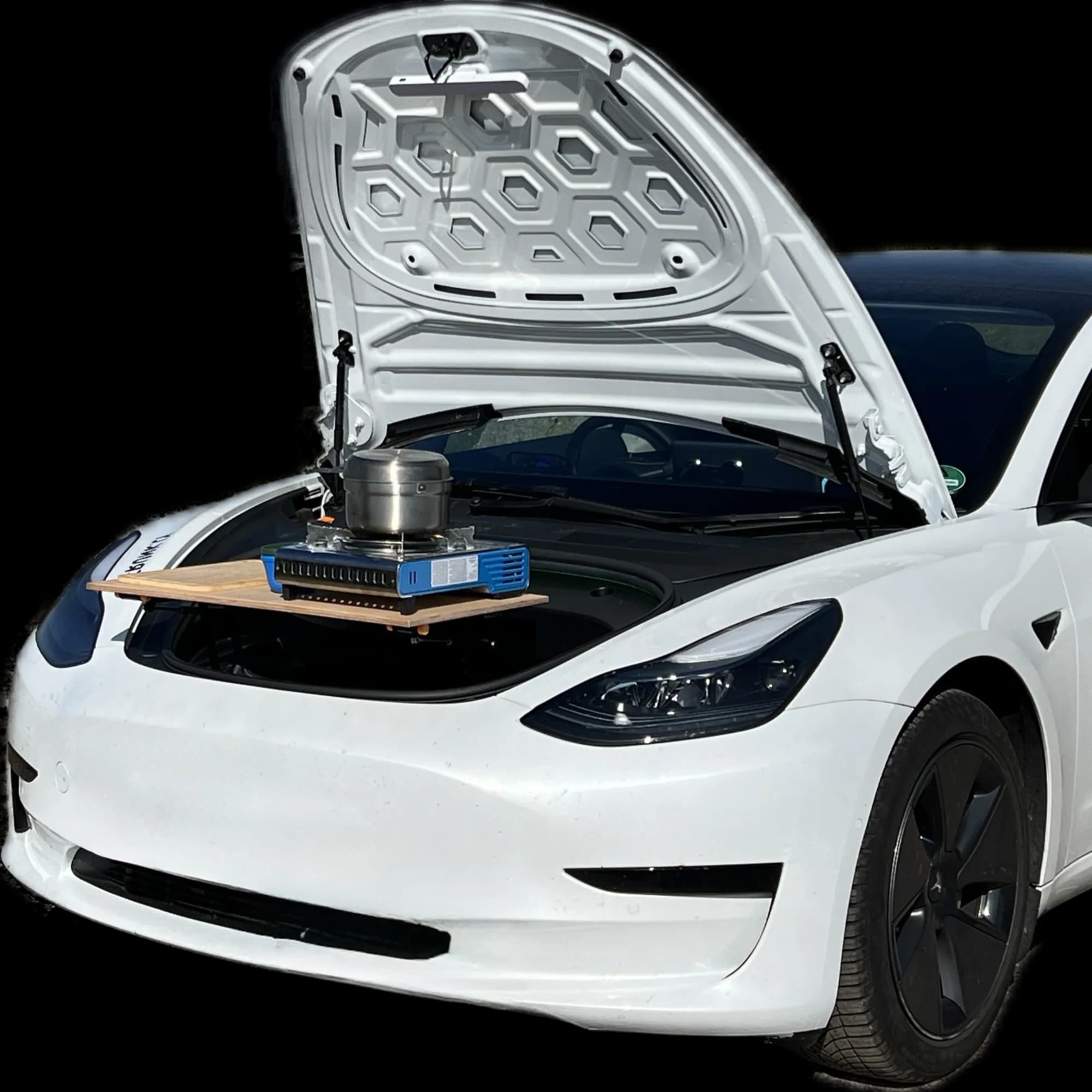
Bonus: the Frunkly LT stays installed and gives you a stable breakfast surface as soon as you pop the lid. Unfolds in under 10 seconds, holds 10 kg. Opening the frunk at night doesn't spill light onto the sleeping area, unlike opening the trunk.
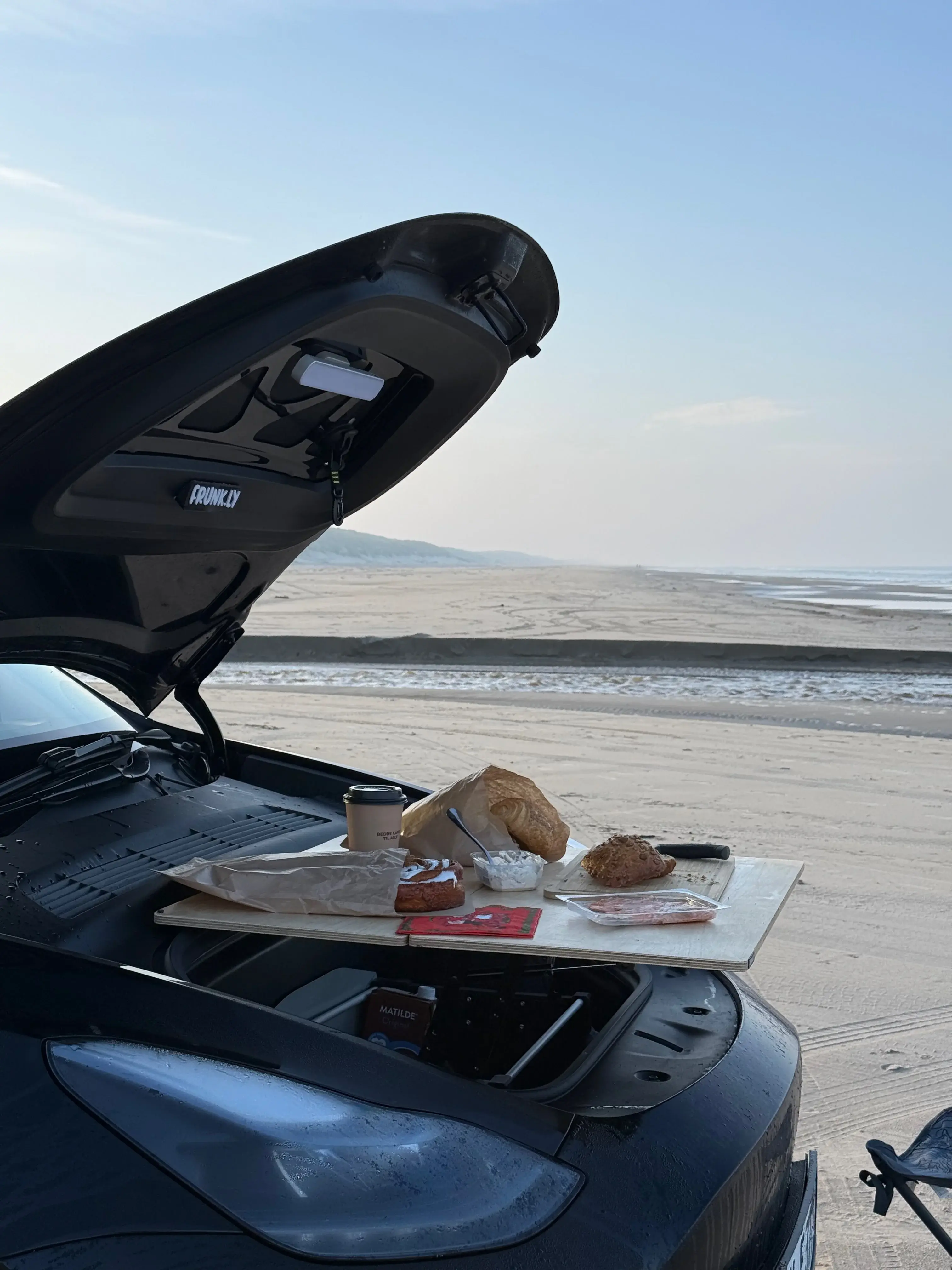
Breakfast on the Frunkly LT in a Tesla Model Y
Overnight charging in Germany
The simplest answer to battery anxiety is an 11 kW wallbox. In 8 hours you add ~88 kWh, and the Camp Mode draw doesn't register.
Stellplatz with wallbox. Availability in 2024/2025 is mixed. The Bordatlas Stellplatzführer 2024 lists about 3,800 Stellplätze in Germany; Park4Night filters by power icon. Typical cost: €0.45-0.70 per kWh, or €1-2 per hour flat at coin meters. ADAC quotes €0.54 per kWh as the average for public AC charging.
Destination Chargers at hotels. Tesla lists hundreds of German hotels with free or low-cost charging for guests. Roughly 80% are free for guests, the rest charge a small fee. Access usually requires being a hotel guest, so call ahead or filter the Tesla map.
Apps that actually help:
- Park4Night: Stellplätze and free overnight spots, community-rated
- Bordatlas Stellplatzführer: curated motorhome sites
- PlugShare: charging stations with photo reviews
- A Better Route Planner (ABRP): plans charging stops into your route
Etiquette: Superchargers are not for overnight stays. Idle fees kick in 5 minutes above 100%. Charge fast and move on to a Stellplatz or hotel.
Where you can legally sleep
Germany: the one-night rule. Traffic law (§12 StVO interpretation) permits sleeping in a vehicle for the purpose of "restoring driving fitness". Police practice in 2024/2025: one night, about 10 hours, no camping setup outside, is generally accepted.
What's allowed:
- Sleeping in your car on public parking lots, Autobahn rest areas, or unrestricted Stellplätze
- One night per location
- Inside the vehicle only, nothing set up outside
What gets you fined:
- Setting up camping furniture outside (that turns it into Wildcampen, not restoring fitness)
- Multiple nights at the same spot
- Nature reserves
- Trash or open fires
Fines in 2024/2025 by region:
- Most Länder: €10-50 for a first offense
- Mecklenburg-Vorpommern, Hamburg, Niedersachsen: up to €5,000 in protected areas
- Bavaria and Baden-Württemberg in nature reserves: often €100-500
Police interactions reported in 2024+ forums: Tesla owners on TFF Forum and Reddit consistently report being left alone at Autobahn rest areas and unrestricted trailhead parking, as long as nothing is set up outside and they move on by morning.
Park4Night filter for the right spot:
- "Parking on its own" / "Aire de stationnement": usually fine for one night
- "Camper area" / "Aire de service": official, often paid Stellplatz
- "Establishment": hotels, farms (private property, needs owner permission)
- "Picnic" / "Useful info": day use only, not overnight
Growing legal alternatives:
- Trekkingplätze: official wilderness pitches, around €5-15 per night, advance booking
- LandVergnügen, AlpacaCamping, hinterland.camp: stays at farms and wineries
- Stellplätze: €10-25 per night
Austria: Wild camping outside designated areas is prohibited, only campsites and Stellplätze are legal.
France: Wild camping is forbidden, but "bivouac" (sunset to sunrise, no setup) is tolerated in remote regions. France Passion offers free overnight spots at farms and wineries.
Italy: Officially prohibited, in practice regional. The north and coast are strict, the mountains and the south are more relaxed.
Scandinavia: Right-to-roam (Allemannsretten) in Norway, Sweden, and Finland allows overnight stays on uncultivated land at least 150 m from the nearest house. Europe's most permissive regime.
Respect the spot
No trash, no noise after 22:00, no open fires, no generators. Nothing set up outside the car. Bad behavior by a few campers leads to bans for everyone, and there have been plenty of those in recent years.
Three camping scenarios
1. One night at a rest area or Stellplatz. Minimum setup: mattress in the trunk, sleeping bag, windshield cover plus front side windows, earplugs. Starting SoC 40%+. If the rest area has a Supercharger, top up before bed.
2. Weekend in nature. Add: roof shade, full window shade set, camp chair, camping stove (used outside the car only), 30 L cool bag in the frunk, 7-10 L water container. Starting SoC 50%+, plan for 10-20% drain per night without charging.
3. Multi-week trip. Add: vacuum bags for bedding, organizer on the rear of the front seats, 12V cooler in the frunk (not a soft cool bag), folding table, awning on the roof rack, dry bag for laundry, 20 L water container. Strategy: chain Destination Chargers at hotels for full overnight charging, Superchargers for transit days.
Bonus: mobile workspace during the day. Camp Mode keeps screen, USB-C (laptop directly via PD), and climate live. Mild-weather consumption around 1%/h. Adjust temperature from the app without leaning forward to the screen.
Comfort checklist
Ordered by importance:
- Window shades sized to your model. Privacy, 14-19°C cabin reduction in summer, heat retention in winter.
- Mattress sized to your model. Contour mattress (M3, MY) or self-inflating with R-value 3+ for nights below 10°C.
- Eye mask and earplugs. Highest comfort return per euro.
- 0°C comfort sleeping bag or a double quilt for two.
- USB-C hub with a long cable. Tesla USB ports are up front, your phone ends up in the back.
- Water bottle and thermos. Hot water for morning coffee without firing up a stove.
- Frunk table as a breakfast surface. Stable, clean, no unpacking.
- Window cracked 1-2 cm. Against condensation on the glass.
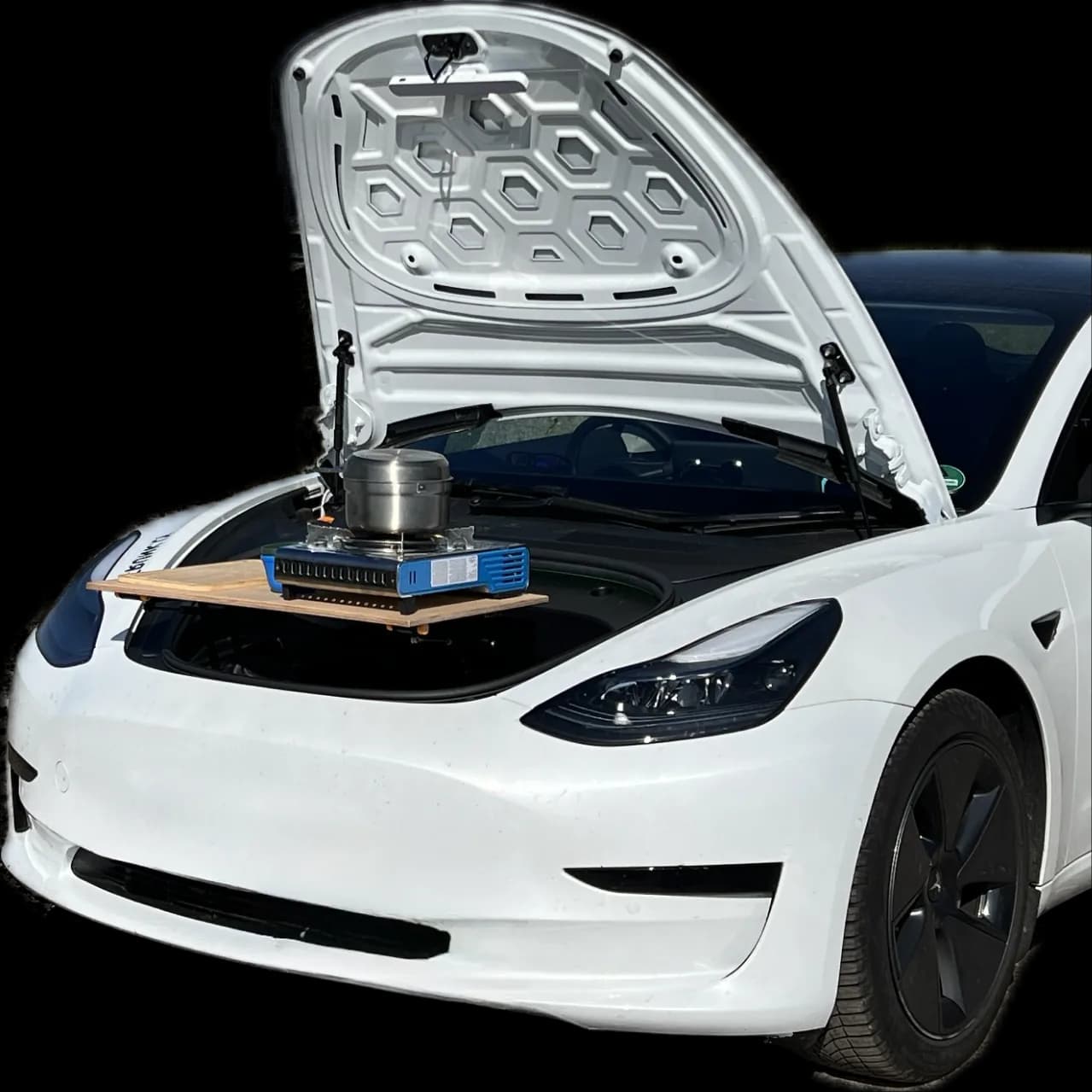
Breakfast without unpacking the car
Frunkly LT
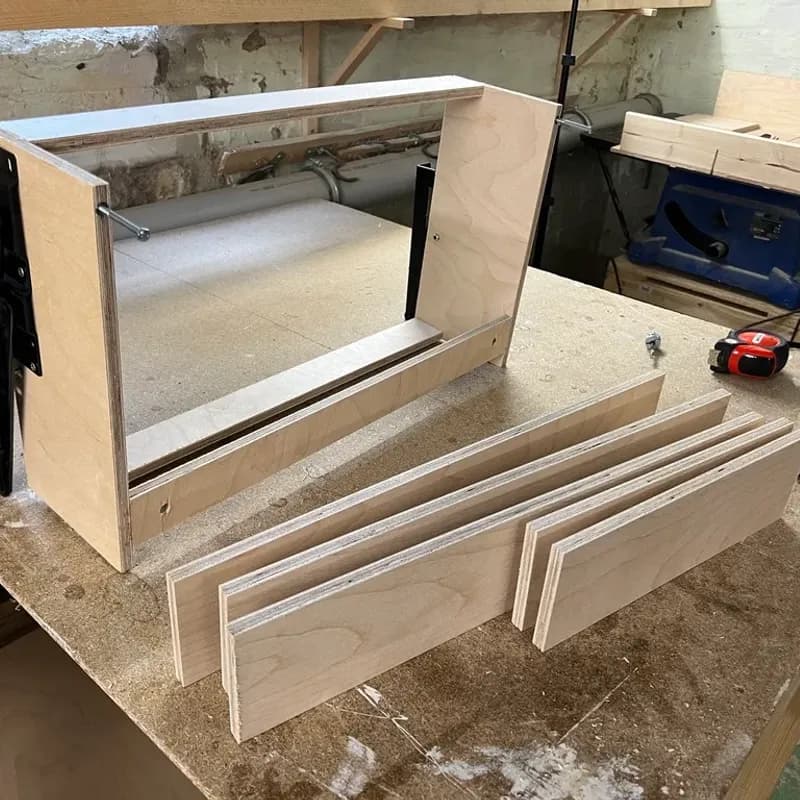
The Frunkly LT stays installed in the frunk, unfolds in under 10 seconds, and gives you a stable surface for coffee and bread. Made in Germany, holds 10 kg, fits Model 3 and Model Y.
View ProductTroubleshooting
Screen too bright to sleep. Set brightness to minimum and enable night mode. Alternatively use the screen-cleaning mode to turn the display off temporarily.
Camp Mode ends after several hours. Tesla caps the continuous runtime. Tap Camp again, you can do this as often as you want.
Heating weakens below 20% SoC. The car actively throttles to protect range. Fix: charge before the night.
Inside of the glass is fogged in the morning. Switch from recirculation to fresh air, crack a window slightly, banish wet clothes to the frunk, and park nose-down.
Fan spools up and wakes me. Set the target temperature closer to the outside temperature. At 8°C outside, target 18°C instead of 22°C.
Software update in the middle of the night. Set the update window in settings to a daytime hour.
Frequently asked questions
How do I turn on Camp Mode on a current Tesla?
What does Camp Mode automatically disable?
How much battery does Camp Mode use per night?
Which Tesla models work for sleeping?
Do I need a special mattress for my Tesla?
What helps against fogged windows in the morning?
How loud is Camp Mode at night?
Is sleeping in a Tesla legal in Germany?
Can I charge while in Camp Mode?
Do heated seats work in Camp Mode?
Next steps
Camp Mode turns the Tesla into an honest overnight vehicle once you know the basics: activate it correctly, get the right mattress and window shades, start with at least 25% charge, use fresh air instead of recirculation. To dig further, see which Tesla camping table fits your trip and our Tesla camping packing list. Matched to your car: the frunk table for the Tesla Model Y and the Tesla Model 3.

Related Posts
Ready for Your Next Adventure?
Your Tesla can do more. With Frunkly, transform your frunk into a practical workspace in seconds.